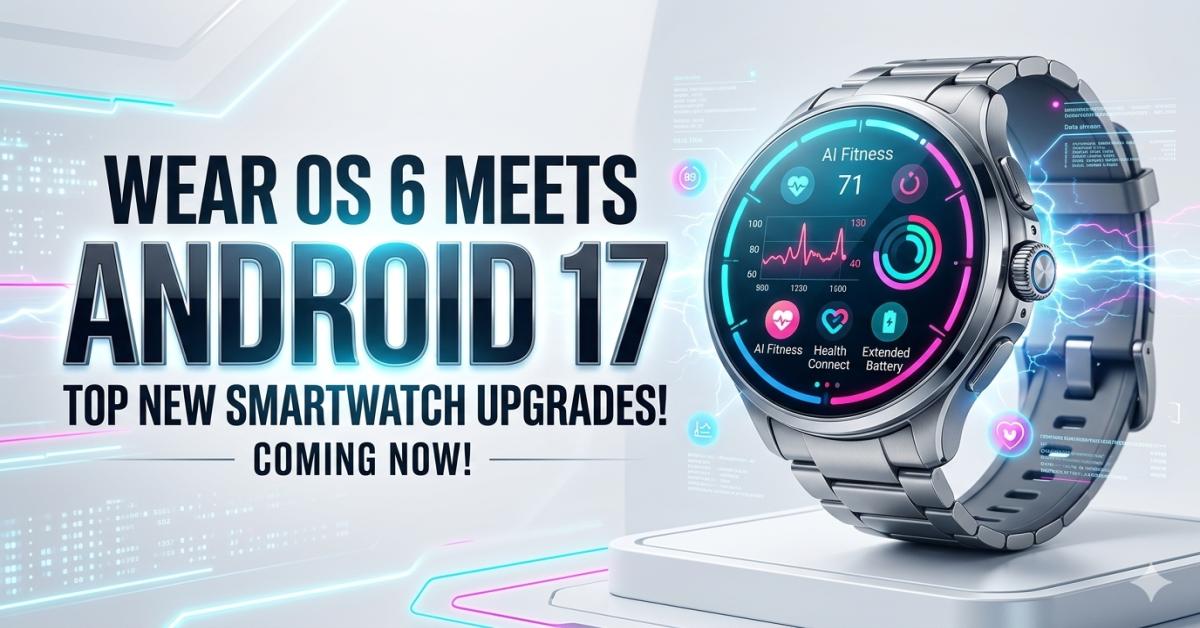
Wear OS 6 Meets Android 17: Top New Features Coming to Your Smartwatch (2026)
Discover the future of wearables. From Hybrid Interface 2.0 for 100-hour battery life to standalone Gemini AI features, here is how Wear OS 6 and Android 17 are redefining smartwatches in 2026.
Make Someone's Day
Share this incredible guide!
The synergy between smartphones and wearables has reached a fever pitch in 2026. With the rollout of Android 17, Google has simultaneously unveiled Wear OS 6, a massive architectural leap designed to bridge the gap between high-performance computing and extreme battery efficiency. For power users in the USA, Canada, and Australia, this update isn't just about new watch faces—it is about a fundamental shift in how biometric data is processed and how AI lives on your wrist.
As an Android developer and electronic circuit simulation engineer, I have spent weeks analyzing the low-power co-processor (MCU) handling in the latest Wear OS builds. In this guide, we will break down the top features of Wear OS 6, the deep integration with Android 17, and why 2026 is finally the year the "Smartwatch Battery Problem" was solved.
1. Hybrid Interface 2.0: The Secret to 100-Hour Battery Life 🔋
The most significant technical achievement in Wear OS 6 is the Hybrid Interface 2.0. In previous generations, the power-hungry Application Processor (AP) had to wake up for almost every notification or UI interaction. Wear OS 6 changes the game by offloading significantly more tasks to the ultra-low-power co-processor (MCU).
The Circuit Logic: Dual-Enclave Execution
In 2026 flagships like the Galaxy Watch 9 and Pixel Watch 4, the MCU now handles the entire "Always-On Display" (AOD) rendering and real-time sensor fusion without ever waking the main SoC. This is achieved through a shared memory buffer that allows the co-processor to update health metrics (like heart rate and steps) directly onto the display's frame buffer. For the user, this translates to a sustained 4-5 day battery life even with all health tracking features active.
- Smart Switching: The OS intelligently switches between the ARM Cortex-M and Cortex-A cores based on the complexity of the task.
- Thermal Efficiency: Reduced AP wake-time means less heat generation near the skin, improving sensor accuracy.
2. Advanced Health Connect: Real-Time Biometric Streaming 💓
Android 17 introduces an upgraded Health Connect API that acts as a centralized vault for your medical and fitness data. Wear OS 6 leverages this by allowing "Inter-App Biometric Streaming." This means your watch can now stream raw PPG (Photoplethysmogram) data directly to third-party medical apps in real-time with enterprise-grade encryption.
Precision Monitoring in 2026
The integration of the PMIC (Power Management IC) with the new bio-sensors allows for higher sampling rates during sleep and intense workouts without the typical battery drain. Whether you are tracking VO2 Max, Sleep Apnea, or Blood Glucose trends, the data is now processed locally using on-device ML (Machine Learning) before being synced to your phone’s private space.
- Optimization: AI-Powered Battery Care & Health Longevity
- Security: Android 17 Security Guide for Wearable Data
3. Standalone Gemini AI: A Voice Assistant That Actually Works 🤖
Gone are the days when your watch was just a remote control for your phone's Google Assistant. Wear OS 6 brings a distilled version of Gemini Nano directly to the wearable hardware. This allows for offline voice processing and "Contextual Smart Replies" that don't require an active LTE or Wi-Fi connection.
On-Device NPU Utilization
Modern wearable chips in 2026 now include a tiny NPU (Neural Processing Unit). Wear OS 6 uses this to analyze your speech patterns and physical environment. If you are in a loud gym, the AI uses "Neural Noise Suppression" to isolate your voice. It can also summarize your daily notifications and prioritize them based on your current activity—if you are driving, it only announces urgent messages.
- Boost Efficiency: Hidden Google Gemini Routines Guide
- Experimental: Android 17 Beta Hidden AI Settings
4. Material You 3.0: Seamless UI Across Devices 🎨
With Android 17’s refined Material You 3.0, the visual continuity between your phone and watch is seamless. The color palette extracted from your phone's wallpaper is automatically pushed to your watch face and system UI using the new Watch Face Format (WFF).
Dynamic Complications
Complications in Wear OS 6 are no longer static icons. They are mini-widgets that can display live data, such as a real-time stock ticker, a live sports score, or a countdown for your Uber. Because these are rendered using the co-processor (thanks to WFF), they don't impact battery life.
5. Standalone Performance & "Watch-First" Apps ⌚
In the Tier-1 market, users are increasingly leaving their phones at home while running or at the gym. Wear OS 6 doubles down on the "Standalone" philosophy. The Play Store for Wear OS now features apps that are fully functional without a companion phone app.
Enhanced LTE Handover
The radio stack in Wear OS 6 has been optimized for the 5.5G (5G-Advanced) standard. Handover between your phone's Bluetooth connection and the watch's LTE is now instantaneous and invisible to the user. This is crucial for streaming high-fidelity audio or taking VoIP calls on the go.
- Compatibility: Samsung Android 17 & Wear OS Update List
- Hardware Check: Android 17 & Wearable Requirements
6. Private Space Integration: Security on the Wrist 🛡️
Android 17’s Private Space feature extends to Wear OS 6. You can now choose to mirror notifications from your phone's Private Space to your watch only when it detects a secure biometric lock (like your wrist being detected or a PIN entry). This ensures that sensitive banking or work notifications aren't visible to anyone glancing at your wrist.
7. Weekend Read: Tech-Free Lifestyle 🍰
Even with the most advanced Wear OS 6 features on your wrist, everyone needs to unplug. If your smartwatch tells you that your stress levels are high and it's time for a break, why not spend your weekend exploring some classic culinary delights? Sometimes the best "wearable" is a kitchen apron.
- Refuel: Guryev Porridge Recipe for Techies
- Classic Treat: Medovik Honey Cake Recipe
- Quick Break: Apple Charlotte Recipe
- Post-Workout: Sweet Pancakes with Curd
Final Thoughts: Is Wear OS 6 the Real Winner?
While Android 17 brings the power, Wear OS 6 brings the utility. The combination of Hybrid Interface 2.0, standalone AI, and deep health integration makes it a formidable competitor to Apple's watchOS. If you are planning to upgrade to a 2026 flagship, ensuring your smartwatch is Wear OS 6-ready is the best move you can make.
Check our Android 17 Flagship Guide to see which phones pair best with the new Wear OS ecosystem. ⚡
Wear OS 6 features, Android 17 smartwatch compatibility, Galaxy Watch 9 Wear OS update, Wear OS vs watchOS 2026, Pixel Watch 4 features, standalone AI smartwatch.
Guide Details
| Views | 27 |
| Category | Android Updates & News |
| Published | 26-Mar-2026 |
| Last Update | 21-Jun-2026 |
|
30
|
|