Li-Po vs. Li-Ion Power Banks: Portable Energy
A comprehensive technical comparison of Lithium Polymer (Li-Po) and Lithium-Ion (Li-Ion) power banks in 2026. Discover which chemistry offers better safety, longevity, and fast-charging performance for modern smartphones and laptops.
Make Someone's Day
Share this incredible guide!
The modern power bank has evolved from a clunky emergency accessory into a sophisticated piece of hardware essential for digital professionals and power users. However, a fundamental question remains for every buyer: Should you choose Lithium-Ion (Li-Ion) or Lithium Polymer (Li-Po)?
While marketing materials often use these terms interchangeably, the underlying engineering governs everything from device longevity to safety profiles and thermal management. In this definitive guide, we analyze the architectural differences between these two lithium-based technologies to determine which is best for the latest generation of mobile devices.
Essential Reading for Power Users:
- System Performance: Optimizing OS Performance for High-Drain Apps
- Hardware Leaks: Next-Gen Chipset: Power Consumption vs. Efficiency
- Battery Longevity: How AI-Powered Battery Care is Doubling Device Life Cycles
1. Architectural Foundations: Liquid vs. Gel Electrolytes
To understand the performance gap, we must look at the internal chemistry. All lithium batteries function by moving lithium ions between a cathode and an anode through a medium known as the electrolyte.
Lithium-Ion (Li-Ion): The Rigid Workhorse
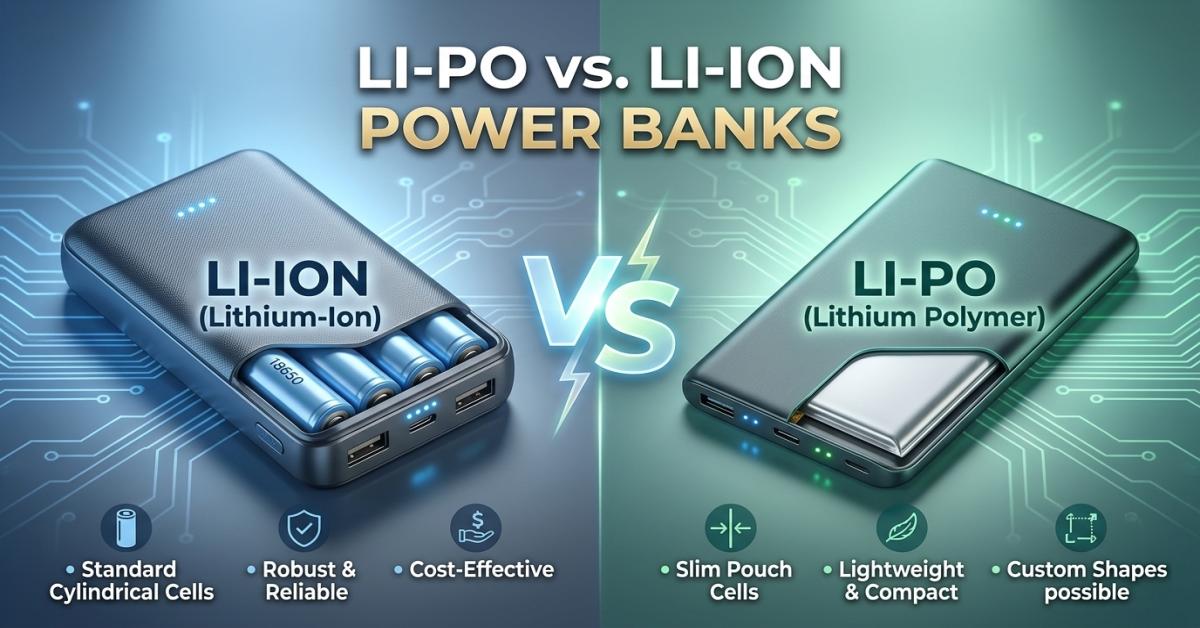
Traditional Li-Ion batteries utilize a liquid organic solvent as the electrolyte. Because liquids are volatile and prone to leaking under pressure, these cells must be housed in rigid metal canisters—typically the cylindrical 18650 or 21700 formats. This is why high-capacity Li-Ion power banks often have a sturdy, solid build.
Lithium Polymer (Li-Po): The Flexible Evolution
Lithium Polymer (technically Lithium-Ion Polymer) uses a high-conductivity gel or a solid polymer as the electrolyte. Since there is no liquid to leak, these batteries do not require a heavy metal shell. Instead, they are encased in a flexible aluminum-plastic pouch. This "pouch cell" design is what allows modern flagship smartphones to remain thin while packing high-capacity cells.
Expert Insight: Most "Ultra-Slim" power banks designed for high-end smartphones utilize Li-Po cells to maintain a thickness of less than 12mm without sacrificing total capacity.
2. Energy Density: Volumetric vs. Gravimetric Performance
When comparing energy density, the ideal choice depends on the specific use case and portability requirements.
- Volumetric Density: Li-Ion usually excels here. Cylindrical Li-Ion cells can pack more energy into a specific 3D volume, making them the industry standard for high-capacity 25,000mAh+ units and laptop battery packs.
- Gravimetric Density (Weight): Li-Po is significantly lighter. By removing the heavy steel or aluminum casing of Li-Ion, Li-Po cells offer a much higher power-to-weight ratio.
For users who prioritize minimal weight during travel or daily commutes, the weight savings of a Li-Po unit provide a tangible advantage over traditional designs.
3. Safety Profiles: Thermal Management and Failure Modes
Safety is a paramount concern in portable energy. While modern Battery Management Systems (BMS) have significantly reduced risks, the physical failure modes of these two chemistries remain distinct.
The Li-Ion Pressure Dynamics
Because Li-Ion cells are encased in rigid metal, a failure caused by a short circuit or overcharging—known as thermal runaway—can lead to internal pressure build-up. While quality cells include mechanical venting features, the failure mode is generally more abrupt compared to non-rigid designs.
The Li-Po Swelling Indicator
When a Li-Po battery degrades or is exposed to excessive heat, it produces gas that causes the pouch to swell or bloat. While this can physically expand the power bank's casing, it serves as a critical visual safety signal. A bloated battery is a clear indicator that the chemistry has reached its end-of-life and must be recycled safely.
4. Charging Speeds and Heat Dissipation
With the widespread adoption of high-wattage Power Delivery (PD) standards, heat management is critical. Li-Po cells generally have a larger surface area relative to their volume, allowing them to dissipate heat more effectively during high-amperage rapid charging. This efficiency is vital for maintaining the health of the device as discussed in our Battery Optimization Guide.
Li-Ion, conversely, is highly efficient at maintaining a consistent voltage output over long durations, making it the preferred choice for portable power stations and high-performance hardware that requires a steady stream of energy.
5. Longevity: Understanding the Cycle Life
A common misconception is that all lithium batteries degrade at the same rate. In reality, Li-Ion typically offers superior longevity in terms of total cycles.
- Li-Ion: High-quality cells can often handle 800 to 1,500 full charge/discharge cycles before capacity drops to 80% of its original rating.
- Li-Po: Generally begins to show signs of capacity degradation after 400 to 600 cycles due to the chemical stability of the polymer electrolyte over time.
For users seeking a long-term investment that will last for several years of daily use, a premium Li-Ion power bank utilizing high-grade 21700 cells is often the more durable choice.
6. The Future: Solid-State and Beyond
Looking ahead, the industry is moving toward Solid-State batteries, which aim to combine the safety and slim profile of Li-Po with the energy density of Li-Ion. Until then, choosing between the two requires balancing the need for portability against the need for high-cycle durability.
Comparison Summary: Li-Po vs. Li-Ion Matrix
| Feature | Lithium-Ion (Li-Ion) | Lithium Polymer (Li-Po) |
|---|---|---|
| Form Factor | Rigid, cylindrical casing | Slim, flexible pouch |
| Safety Profile | Internal pressure / Venting | Physical swelling / Bloating |
| Cycle Life | 800 - 1,500 Cycles | 400 - 600 Cycles |
| Weight | Heavier per mAh | Lighter per mAh |
| Self-Discharge | Very Low | Moderate |
Conclusion: Which Technology Fits Your Needs?
The choice between Li-Po and Li-Ion depends entirely on your usage patterns. If you require an ultra-portable solution that fits easily into a pocket or laptop sleeve, Lithium Polymer is the standard for modern convenience.
However, for power users who need high-capacity energy for professional hardware like the S26 Ultra or high-end cameras, the rugged reliability and superior cycle life of Lithium-Ion remain the engineering gold standard.
Recommended Gear Guides:
- Next-Gen Foldable Phones (Optimized with Li-Po Technology)
- Power Bank Compatibility for High-Speed Charging
- How Battery Efficiency is Transforming Modern Smartwatches
Stay ahead with expert insights on hardware and performance optimization.
Lithium Polymer vs Lithium Ion power bank 2026, Li-Po vs Li-Ion safety, best power bank for iPhone 17, portable charger battery types, energy density 2026, solid-state battery vs Li-Po, fast charging power bank guide
Guide Details
| Views | 56 |
| Category | Android Updates & News |
| Published | 26-Mar-2026 |
| Last Update | 19-Jun-2026 |
|
30
|
|