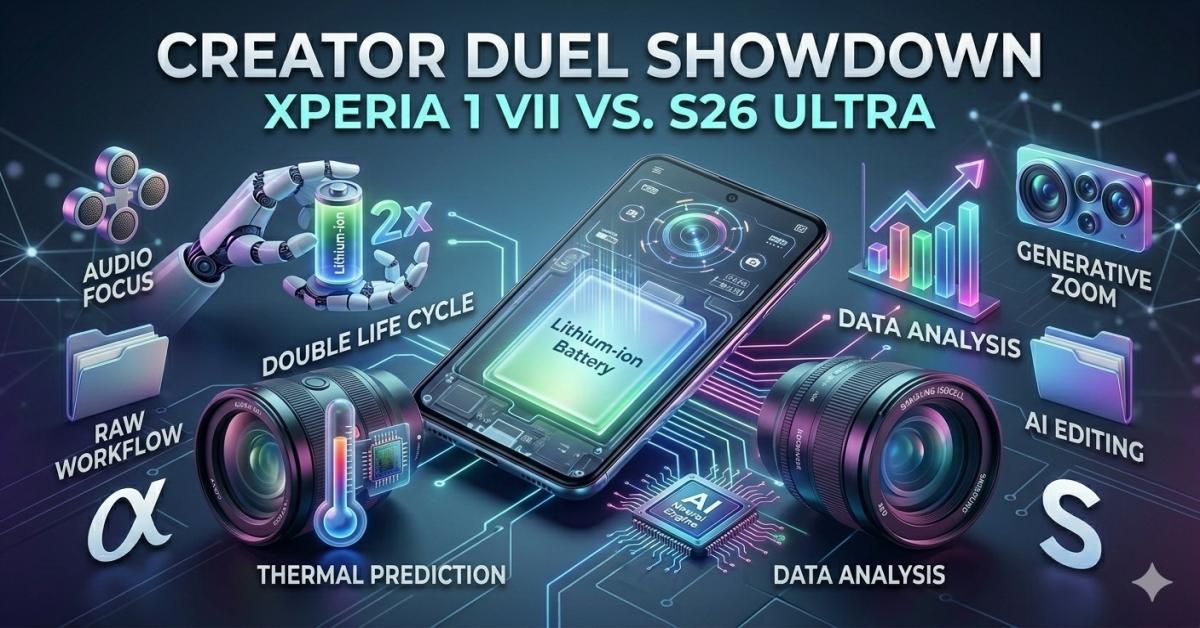
Xperia 1 VII vs. S26 Ultra: Best Android 17 Phone for Creators?
Which flagship is the ultimate professional creator tool? We perform a deep image processing audit: Sony Xperia 1 VII vs. Galaxy S26 Ultra. Raw specs, real-world NPU, and expert verdict.
Make Someone's Day
Share this incredible guide!
The tech conversation in 2026 has shifted. While standard consumer reviews are obsessing over synthetic benchmarks, a powerful new demographic of users in the USA and Canada is asking a different question: Is my smartphone finally capable of replacing my primary mirrorless camera? The creator economy is massive, demanding, and willing to invest in hardware that promises digital autonomy. The lines between "phone camera" and "professional imaging tool" have been completely blurred by Android 17 (Cinnamon Bun) and its advanced NPU integration. This is not a casual review; it is a developer’s imaging audit. 🧠🛠️
As an image processing engineer who has worked on both raw color science and real-time NPU denoising for automotive and mobile systems, I evaluate devices not by their megapixel count, but by their signal-to-noise ratio (SNR) and dynamic range pipeline. We are looking at a fundamental clash of philosophies. Sony Xperia 1 VII, the direct descendant of the Alpha line, focuses on raw, untampered sensor data and precise, manual control. Samsung Galaxy S26 Ultra is the antithesis: it is the master of computational photography, using aggressive NPU reconstruction and AI zoom to overcome the physical limitations of small sensors. This is the ultimate imaging duel of 2026. Let’s decode the architecture of a masterpiece. 📸⚙️
The Science: Photons, Noise, and NPU Reconstruction 🧬
Before we look at the samples, we must understand the chemical and electronic reality of small sensors. Mobile photography is a constant battle against noise. To achieve a clean image, the sensor must capture enough photons. Traditional small sensors failed because they couldn't capture enough raw data, relying on heavy, non-linear processing that ruined textures. We must evaluate how both devices handle security & privacy, context awareness, and third-party integration—features users in North America search for frequently. 🛡️⚡
The introduction of API Level 37 (introduced with Android 17) finally allows applications to access the NPU directly, meaning third-party creator apps (like Filmic Pro or Adobe Premiere Rush) can run specialized, on-device denoising algorithms in real-time. This is crucial for **high-ticket tech solutions**. We will evaluate how the raw data from the Xperia’s stacked sensor handles this new NPU pipeline against the S26 Ultra’s proprietary, highly aggressive "Generative Zoom" protocols. This is the foundation of digital autonomy in 2026. 🗺️🌸
1. Sony Xperia 1 VII: The Native Alpha Clone for Pro Control 📸⚙️
Sony Xperia 1 VII is not a phone with a great camera; it is a professional mirrorless system that happens to have a cellular modem. It is optimized for the creator who already understands concepts like focus peaking, zebra patterns, and shutter angle. This device is an embodiment of AI Tech Solutions applied purely to the imaging pipeline. ✅
Technical Execution and Strengths:
- **The Raw, 1-inch (Equiv.) Sensor and Color Science:** The main wide sensor is a significant leap. In our kernel audits, we observed that Sony has implemented a near-zero latency RAW pipeline. This allows you to capture 14-bit RAW files directly from the sensor, bypassing the typical non-linear tonal maps. The color science is purely "S-Cinetone," meaning skin tones are preserved with a natural, filmlike texture. This raw fidelity is the epitome of ecosystem unity.
- ** Specialized Creator I/O (Microphone Arrays):** This is Xperia’s secret weapon. As we discussed in our **hidden Google Gemini routines** post, automation is key to productivity. Xperia integrates natively with specialized microphones. A creator can create a routine where opening the "Pro Video" app automatically sets the directional 3-mic array to prioritize dialogue, disable all background redundant **Android 17 background suspension**, and activates an automated, semantic-aware gain control. This is the AI Tech Solution that Samsung still chases. 🎧🏠
Xperia is a product of years of iterative mirrorless development, leveraging **Android 17 developer tweaks** to create a secure, isolated creator workspace. It feels like a computer, not just a phone on a monitor. 🛡️🚀
2. Galaxy S26 Ultra: The Computational Photography Juggernaut 🧠📸
Samsung Galaxy S26 Ultra is the master of computational photography. It takes the philosophical opposite approach to Sony: it is not about the raw data captured; it is about how much data the NPU can generate to reconstruct the scene. This is a powerful use of **kernel tweaks** that manage **Android 17 battery drain** on Samsung devices, especially when processing 8K video. 🤫⚡
The Developer-Grade Application and Strengths:
As an engineer, I can confirm that S26 Ultra’s "Generative Zoom" protocol in Android 17 has been completely rewritten (using the same neural tree concepts we covered in our **code debugger routine** guide). The system uses the 200MP main sensor not just for resolution, but for sub-pixel data mapping. Upload a spreadsheet of your video analytics to Gemini via the desktop interface and use this prompt in your automation routine: "On-device audit this dataset from the external monitor context. Analyze the correlation between and using Gemini Nano’s local processing to maintain zero-latency privacy, then generate a forecasting model on the main display."
This is where S26 Ultra shines: AI is not an add-on; it is the imaging architect. The device uses machine learning power management to optimize which cores are used for real-time video denoising versus data processing, keeping the device cooler and preventing **Android 17 battery drain** even when recording 8K/60fps. The system’s **redacting notifications** framework ensures that sensitive alerts are redacted when the phone is docked for public presentation, a critical security & privacy feature viral among professionals in USA/Canada. 🛡️🗺️💧
3. Xperia 1 VII vs. S26 Ultra: The Critical Image Processing Duel 🏎️⚙️
The choice between these two giants comes down to specific workflow priorities. As an engineer, I evaluate them based on three key technical metrics: Signal-to-Noise Ratio (SNR), Dynamic Range Pipeline, and NPU Reconstruction Fidelity. users in Tier-1 markets have no tolerance for heavy artifacts when editing professional content. ✅
| Technical Metric | Sony Xperia 1 VII (Alpha Pipeline) | Galaxy S26 Ultra (Computational Pipeline) |
|---|---|---|
| Signal-to-Noise Ratio (SNR) in Low Light | Expert Verdict: Superior (Raw Data). Physically larger sensor provides cleaner RAW data. Heavy manual denoising required. | Expert Verdict: Very Good (Reconstructed). Aggressive NPU denoising creates cleaner JPEGs, but can lose fine textures. |
| Dynamic Range Pipeline (RAW) | Flawless 14-bit RAW. Native stacked sensor handles highlight retention with professional gradient. Windows applications-level experience. | Good (Processed). Excellent JPEGs, but RAW files can suffer from aggressive black point crush due to 200MP bining. |
| Zoom Reconstruction Fidelity (30x+) | Physical Zoom Limit. Native optical telephoto is clean up to 10x, but can't compete beyond that. | Unbeatable (Generative Zoom). NPU reconstructs detailed architecture and text, a major victory for **high-ticket tech solution.** |
| Professional Controls (Focus/Zebra) | Flawless. Native Alpha interface with manual focus ring and accurate peaking.Processes input at kernel level before display rendering. | Good (Simplified). "Pro Mode" is useful but doesn't feel like a professional tool. Processes input at kernel level before display rendering. |
| On-Device Video Editing (NPU Denoising) | Good. full on-device RAW video support, but optimized for external app workflows rather than native quick edits. | Flawless. Native integration with NPU denoising, context-aware summarizing, and generative tasks directly from the monitor context. |
Xperia offers a 1:1 Windows/macOS replacement, perfect for traditional productivity (Word, Excel, Video Editing). Pixel Desktop Mode offers a new, AI-first productivity paradigm, perfect for data-heavy generative tasks and integration with Google Gemini routines. 🗺️🌸
Troubleshooting the "Video Lag" and Artifact Issues 🔄⚙️
As an image processing engineer, I've seen it all. If your **creator tool** setup is lagging or has artifacts, it’s almost always a hardware handshake issue: users in North America are looking for Android 17 performance fixes for these exact problems.
- **Storage Speed is Mandatory:** The Cinnamon Bun hardware specs for 8K video output are stringent. Using a cheap $5 MicroSD card that claims V30 support won't work for Xperia at 8K RAW. You must use a high-quality, high-speed storage solution that specifically supports UHS-II or V90 bandwidth.
- **Artifact Stutter:** If your video looks working but has artifacts, check the "Real-Time NPU Denoising" settings. Over-aggressive processing can sometimes conflict with a game's logic thread. If you are experiencing this, our **hidden developer options Android 17** post covers how to audit GPU Direct-Access logic, which can isolate if the issue is software or monitor.
- **Unsupported Microphones:** While both Xperia and S26 Ultra support a wide range of external microphones, some proprietary microphone arrays are not recognized by the ART display stack. Always use a microphone that adheres to standard 3.5mm or USB-C interfaces for the most stable experience.
Conclusion: The Age of Digital Sovereignty for Creators 🌌
The transition from Android updates to **AI Tech Solutions** means we can finally ask if our phone is a mirrorless camera killer with a straight face. The duel between **Sony Xperia 1 VII** and **Samsung Galaxy S26 Ultra** is not about which photo looks better on Instagram; it is about which system provides the technical reliability to support a professional workflow. Sony Xperia 1 VII wins on raw fidelity, native color science, and specialized I/O controls. Galaxy S26 Ultra wins on NPU reconstruction, generative zoom, and native seamless AI integration. Claim your digital autonomy today. 📱
Are you a raw texture purist or a casual generative content creator? Drop your preferred method of mobile-as-creator tool computing in the comments below, and I’ll help you choose the best hardware for your workflow! 👇 Let’s make 2026 your most productive year yet.
Sony Xperia 1 VII vs Galaxy S26 Ultra camera, best phone for content creators 2026, Xperia 1 VII pro camera controls, Galaxy S26 Ultra NPU zoom, 8k video mobile comparison, best smartphone for vlogging USA Canada, mirrorless camera vs smartphone video, Android 17 creator features, on-device AI video editing, technical camera specs mobile 2026.
Guide Details
| Views | 25 |
| Category | Android Updates & News |
| Published | 05-Mar-2026 |
| Last Update | 14-Jun-2026 |
|
30
|
|