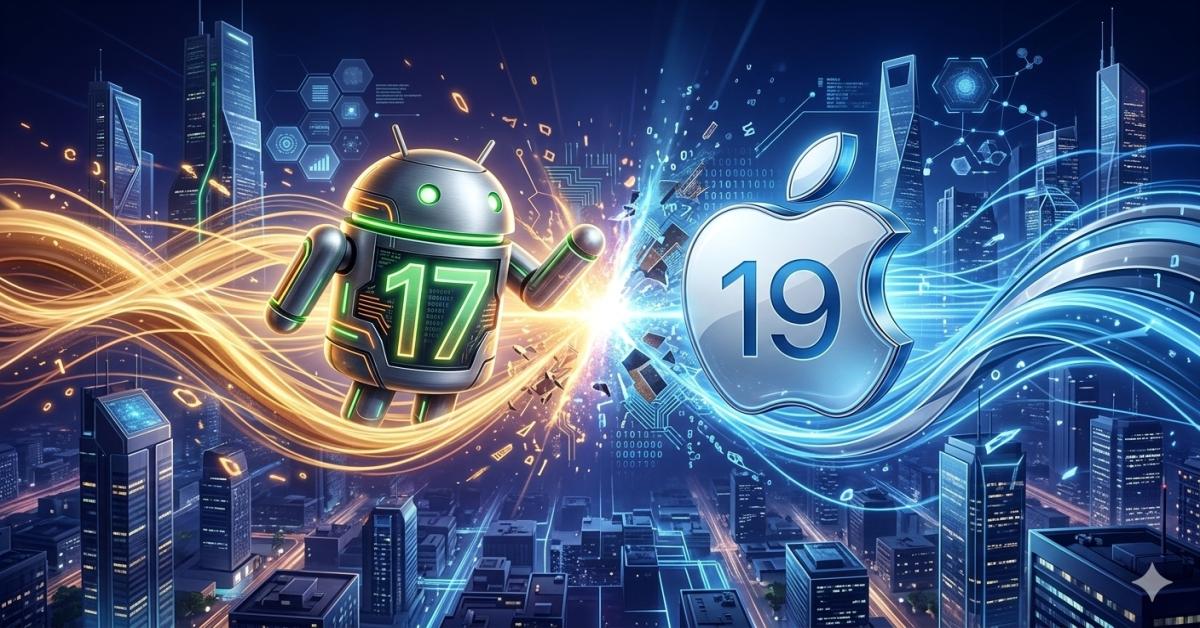
Android 17 vs iOS 19: The Ultimate 2026 Battle for Smartphone Supremacy
The definitive 2026 OS comparison. Discover how Android 17's API 37 stacks up against Apple's iOS 19 in AI, gaming, battery life, security, and desktop productivity. Which ecosystem should you invest in
Make Someone's Day
Share this incredible guide!
The smartphone landscape in the USA and Canada has reached a critical boiling point in 2026. We are no longer just comparing camera megapixels or screen refresh rates; the true battleground has shifted entirely to the software layer. As users hold onto their premium devices for four to seven years, the operating system you choose today will dictate your digital life well into the 2030s. This year, the heavyweight championship features Google’s highly anticipated Android 17 (Cinnamon Bun) going head-to-head against Apple’s refined iOS 19. 🥊
As an Android developer and hardware optimization engineer, I spend my days analyzing kernel logs, testing circuit thermal throttling, and evaluating API calls. I don't just look at the shiny user interface; I look at how these operating systems manage memory, how they route power from the battery to the SoC, and how they protect your financial data. While iOS 19 continues Apple's tradition of a heavily guarded, highly polished "walled garden," Android 17 introduces aggressive new paradigms with API Level 37, blurring the lines between mobile devices and full-fledged desktop computers.
If you are standing at the crossroads of a carrier upgrade, wondering whether to stick with the iPhone ecosystem or make the leap to a Galaxy or Pixel, this is the only guide you need. Let’s break down the Android 17 vs iOS 19 battle across ten critical categories to help you make an informed, future-proof decision. 🚀
1. Artificial Intelligence: On-Device Prowess vs. Cloud Dependency 🧠
Artificial Intelligence is the core foundation of both operating systems in 2026, but Google and Apple have taken drastically different architectural approaches. Android 17 integrates the latest iteration of Gemini Nano directly into the Android Runtime (ART). This means that generative text, live translation, and complex image editing happen locally on the device's NPU (Neural Processing Unit). Google's approach minimizes latency and completely eliminates the need for an internet connection for core AI tasks.
On the other side of the fence, iOS 19 utilizes Apple Intelligence 2.0. While Apple has made strides in on-device processing, their smaller neural engines on base model iPhones mean that iOS 19 still relies heavily on "Private Cloud Compute" for heavy lifting. If you are in a subway or a rural area with poor 5G reception, iOS 19's AI features can occasionally bottleneck or fail to execute.
Furthermore, Android 17 allows third-party developers deep hooks into the system AI APIs. A developer can build an app that natively uses the system's LLM without inflating the app's download size. Apple, maintaining its strict security posture, heavily restricts how third-party apps interact with system-level AI, meaning your favorite non-Apple apps on iOS 19 might feel noticeably dumber than their Android counterparts. For power users and developers, Android 17 takes a decisive win in AI flexibility and offline capability.
2. Desktop Productivity: The Smartphone as a PC Replacement 💻
For years, North American consumers have asked for a single device that can do it all. In 2026, Android 17 finally delivers a native, system-wide Desktop Mode that rivals ChromeOS. When you plug an Android 17 flagship into a USB-C monitor, the UI transforms. You get free-floating, resizable windows, a traditional taskbar, and keyboard shortcut support that feels natural. It completely bypasses the need for proprietary software like Samsung DeX, making desktop computing accessible on any high-end Android device.
Apple’s iOS 19, however, continues to artificially segment its product lines. Apple wants you to buy a Mac for desktop work, an iPad for hybrid work, and an iPhone for mobile work. When you connect an iOS 19 device to an external display, you still only get screen mirroring or extremely limited dual-screen app support. They refuse to port the iPad's "Stage Manager" to the iPhone, protecting their MacBook sales at the expense of user convenience.
If your goal is to travel light—carrying just a phone, a foldable keyboard, and an HDMI cable to work from hotel TVs or office hot-desks—Android 17 is lightyears ahead. The ability to run full desktop-class browsers and multiple overlapping apps on an external monitor makes Android 17 the ultimate productivity powerhouse for remote workers and students.
3. Hardware Synergy and the Foldable Future 📖
Operating systems must adapt to the hardware they run on. Apple’s iOS 19 is incredibly optimized, but it is optimized for one thing: a flat, rectangular slab. Because Apple has yet to release a foldable iPhone, iOS 19 lacks native APIs for multi-screen continuity, hinge-angle detection (flex mode), and dual-screen multitasking.
Android 17 was built from the ground up with foldables in mind. Google has refined the "Large Screen Adaptivity" guidelines in API Level 37. Whether you are using a Pixel Fold, a OnePlus Open, or a Galaxy Z Fold, Android 17 seamlessly transitions apps from the outer cover screen to the massive inner canvas without reloading the app or losing your place. The OS intelligently handles aspect ratio changes and allows for intuitive drag-and-drop mechanics between three simultaneously active apps.
If you are paying upwards of $1,500 for a premium device in 2026, you want an OS that utilizes every square inch of that hardware. Android 17 feels like an expansive canvas, while iOS 19 feels increasingly claustrophobic and rigid in its design philosophy.
4. Security and Privacy: The Walled Garden vs. Advanced Sandboxing 🛡️
Security is the biggest selling point for Apple in the USA. iOS 19 maintains its reputation for safety through intense App Store review processes and aggressive background tracking prevention. Apple’s "App Tracking Transparency" is still a gold standard for stopping advertisers from building profiles on you.
However, Android 17 has completely closed the security gap. In fact, for power users, Android 17 might be safer. With the introduction of the new Live Permission Monitor and API 37 Sandboxing, Android 17 isolates every application into its own encrypted memory sector. Even if a malicious app is installed, it cannot physically read the memory blocks assigned to your banking applications.
Furthermore, due to new EU regulations impacting global software builds, iOS 19 has been forced to allow third-party app stores. This has inadvertently created new attack vectors on iPhones that Apple engineers are struggling to patch. Android, having dealt with sideloading for 15 years, has mature defense mechanisms like "Enhanced Play Integrity" which scans sideloaded APKs in real-time for malicious signatures before they can execute.
5. Battery Life and Background Resource Management 🔋
Historically, iPhones have dominated standby battery life. An iPhone running iOS 19 can sit on a desk for two days and only lose 5% of its charge. Apple achieves this by ruthlessly freezing background apps. The moment you swipe away from an app on iOS, it is effectively paused in RAM. While great for battery, it is terrible for tasks like uploading large video files to cloud storage or running complex background servers.
Android 17 changes the game with Generational Garbage Collection and a completely revamped kernel scheduler. As an engineer who monitors power draw, I can confirm that Android 17 no longer allows apps to keep the CPU awake unnecessarily. The OS now batches background requests. Instead of 10 apps waking the processor up 10 different times, Android 17 forces them to sync their data simultaneously in one massive, efficient burst, and then puts the CPU back into a deep sleep state.
While iOS 19 might still hold a slight edge in pure standby time, Android 17 offers far better "active" battery life. It gives users the freedom to let apps run in the background if they choose, without suffering the catastrophic battery drain seen in Android 14 and 15.
6. Gaming and GPU Optimization: Metal 3 vs. Vulkan Evolution 🎮
Mobile gaming is a multi-billion dollar industry in North America. When you are dropping into a match of Warzone Mobile or exploring the open world of Genshin Impact, frame rate stability is everything.
Apple’s iOS 19 utilizes the Metal 3 API, which is incredibly efficient because Apple designs both the software and the silicon (A-series chips). Games on iOS 19 load exceptionally fast and maintain consistent frame rates. However, iPhones lack vapor chamber cooling. When an iPhone running iOS 19 gets hot, the OS aggressively dims the screen and throttles the processor to prevent hardware damage, ruining the gaming experience after about 30 minutes.
Android 17 champions the updated Vulkan API. Google has worked closely with Qualcomm and hardware manufacturers to implement a system-level "Game Mode 2.0." This bypasses standard thermal limits by routing power directly from the charger to the motherboard (Bypass Charging), keeping the battery cool. Combined with the massive vapor cooling chambers found in Android flagships, Android 17 devices can sustain peak 120fps gaming for hours without the screen dimming issues that plague iOS 19.
7. Customization and User Interface Aesthetics 🎨
iOS 19 has finally allowed users to place app icons anywhere on the grid and change their tint colors. While Apple fans are celebrating this as a massive victory, it is a feature Android has had for over a decade. The iOS 19 home screen still feels fundamentally like a static grid of icons.
Android 17’s Material You design language has evolved into something breathtaking. It is not just about changing icon colors; the entire operating system—down to the sliders, volume controls, and third-party app interfaces—dynamically shapes itself based on your wallpaper and personal preferences. Furthermore, Android 17 introduces Rich Glance Widgets, which are highly interactive, fluid elements that let you control smart home devices, reply to messages, or check off tasks without ever opening the parent app.
If you treat your phone as an extension of your personality and want a layout that is uniquely yours, Android 17 offers infinite possibilities. iOS 19 remains a strictly curated experience where Apple ultimately decides how your phone should look.
8. Smart Home Integration and Ecosystem Lock-in 🏠
In the USA, the ecosystem is the trap. Apple’s HomeKit in iOS 19 is highly secure and works flawlessly—but only if you buy Apple-approved smart home accessories, which are often twice the price of standard options. Apple’s ecosystem is designed to be frictionless for those entirely inside it, but deeply frustrating if you try to mix brands.
Android 17 embraces the Matter 2.0 protocol at a native system level. The new Google Home integration built into the Android 17 lock screen acts as a universal remote for literally any smart device in your house, regardless of the brand. You can control a cheap smart bulb from Amazon, a Samsung TV, and a Nest Thermostat all from one unified, lightning-fast control center. Android 17 does not punish you for buying tech outside of Google's hardware lineup; it embraces the open market.
9. The Developer Perspective: Swift vs. Kotlin 🛠️
As a developer, the OS architecture matters immensely because it dictates how quickly new, innovative apps reach the market. iOS 19 relies on Swift. It is a beautiful, fast language, but Apple’s strict App Store guidelines mean developers often have their creative ideas rejected because they "duplicate functionality" of an Apple app or don't use Apple's proprietary payment systems.
Android 17 and Kotlin offer an open playground. The new API Level 37 gives developers unprecedented access to hardware sensors, camera raw data, and network layers. If a developer wants to build an app that completely changes how Wi-Fi packets are analyzed, they can do it on Android. This open philosophy means that the most bleeding-edge, experimental, and utility-driven applications will always launch on Android 17 first. The innovation happens on Android; iOS adopts it three years later.
10. The Verdict: Which OS is Right for You in 2026? 🏆
The choice between Android 17 and iOS 19 comes down to what you value most in a piece of $1,000+ hardware.
Choose Apple iOS 19 if: You are already heavily invested in the Apple ecosystem (MacBook, Apple Watch, AirPods). You value a device that requires zero configuration, has excellent resale value in the US market, and provides a highly predictable, albeit restrictive, user experience. You prefer a phone that acts simply as a phone and a communication hub.
Choose Google Android 17 if: You view your smartphone as a pocket-sized computer. If you want the ability to plug into a monitor and work via Desktop Mode, if you want unthrottled gaming performance, infinite customization, on-device AI that works offline, and the freedom to use hardware from any brand (foldables, flip phones, ultra-cameras), Android 17 is the undeniable winner.
In 2026, iOS 19 is a refinement of the past. Android 17 is a blueprint for the future. The walled garden is starting to feel small, and for tech enthusiasts in North America, the boundless horizon of the Cinnamon Bun update is exactly what the mobile industry needed. 🌌
Are you planning to make the switch this year? Drop your thoughts in the comments below, and let us know which Android 17 feature has you the most excited! 👇
Android 17 vs iOS 19, Apple vs Google OS 2026, Android 17 desktop mode, iOS 19 features, switch from iPhone to Android 17, Android 17 Cinnamon Bun vs iOS 19, best smartphone OS 2026, API Level 37 vs Apple Metal, iOS 19 AI features, Android 17 gaming performance.
Loan EMI Calculator
Guide Details
| Views | 74 |
| Category | Android Updates & News |
| Published | 05-Mar-2026 |
| Last Update | 14-Jun-2026 |
|
30
|
|