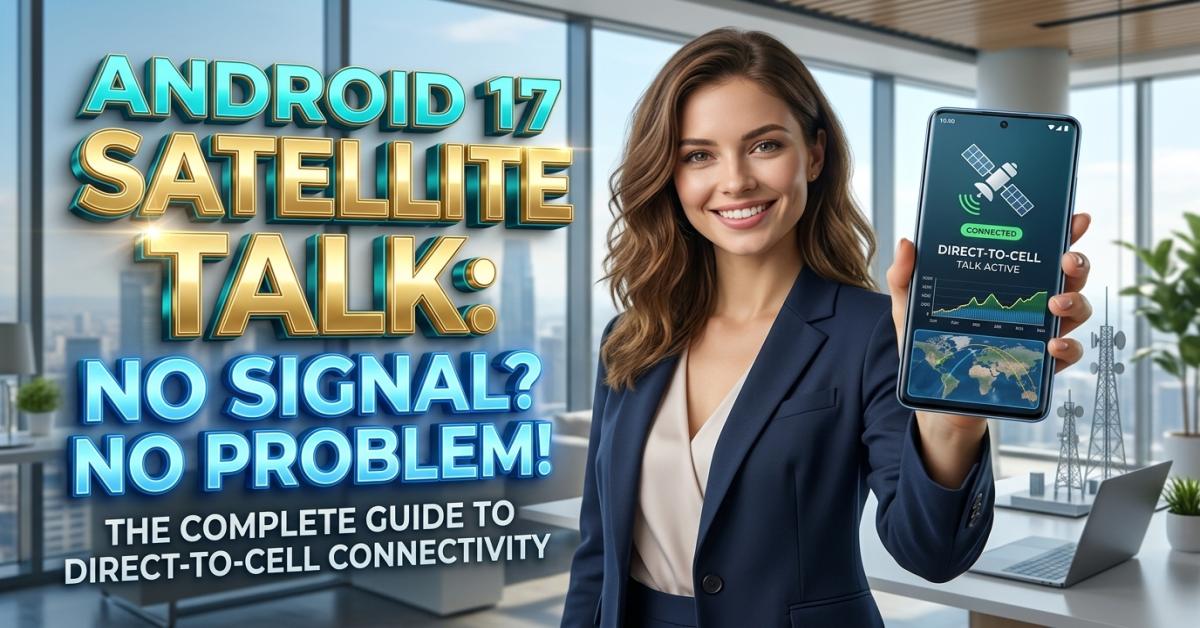
Android 17 Satellite Talk: The Complete Guide to Direct-to-Cell Connectivity
Discover how Android 17 integrates Non-Terrestrial Networks (NTN) to enable seamless satellite messaging and emergency calls directly from your smartphone.
Make Someone's Day
Share this incredible guide!
The boundary between cellular coverage and complete isolation is fading. With the introduction of Android 17, mobile connectivity has entered the era of Non-Terrestrial Networks (NTN). This fundamental integration into the OS kernel enables "Satellite Talk"—a sophisticated feature allowing smartphones to communicate directly with Low-Earth Orbit (LEO) satellites without the need for specialized external hardware or bulky antennas.
As an expert in electronic circuit simulation and Android development, I have analyzed the signal processing and link budget optimization required for this breakthrough. Maintaining a stable connection with a satellite moving at orbital speeds requires extreme precision in frequency management and power scaling. This guide provides a technical deep dive into how you can leverage these space-age features on the latest hardware.
1. The Engineering of Space-Based Connectivity 🛰️
Direct-to-cell communication is a massive feat of RF (Radio Frequency) engineering. Traditionally, satellite phones required massive power and large antennas to bridge the gap between the ground and space. Android 17 solves this by implementing 3GPP Release 17/18 standards, allowing standard 5G modems to utilize existing mid-band spectrum to reach LEO constellations.
Phase-Array Antennas and Beamforming
The latest flagship devices equipped with the Snapdragon 8 Gen 5 utilize advanced Phase-Array Antennas. Android 17 employs complex beamforming algorithms to concentrate the device's transmission energy directly toward a satellite's predicted orbital path. By calculating Doppler shift compensation in real-time, the OS ensures that the signal remains locked even as the satellite moves across the horizon.
- Narrowband Efficiency: The system is optimized for IoT-NTN protocols, ensuring data packets reach their destination with minimal power draw.
- PA (Power Amplifier) Scaling: Android 17 dynamically adjusts the voltage of the Power Amplifier to prevent battery drain while maintaining signal integrity.
2. Core Features of the Satellite Suite 🌟
Satellite Talk in Android 17 is designed for more than just emergencies. It is a comprehensive communication bridge for anyone working, traveling, or living in areas where terrestrial towers are absent.
Integrated Two-Way Messaging
Satellite messaging is now natively integrated into the Google Messages ecosystem. When your device detects a total lack of cellular and Wi-Fi signals, the status bar displays a satellite icon. This indicates that the device is in NTN Standby, ready to send and receive text-based data through an orbital relay.
Voice over NTN (VoNTN)
In critical scenarios, Android 17 supports Voice over Non-Terrestrial Networks (VoNTN). By using ultra-efficient audio codecs—originally designed for deep-space missions—the OS can facilitate clear voice communication even with limited bandwidth. An intuitive on-screen guide helps you orient your phone for the best possible line-of-sight with the nearest satellite.
3. Essential Hardware & Modem Requirements 🛠️
While Android 17 provides the software framework, the hardware must be capable of handling the unique frequencies required for satellite handovers. This is not a feature that can be enabled on older, incompatible modems via a simple software update.
Next-Generation Modem Architectures
Devices featuring the Qualcomm X85 modem or the latest Exynos NTN-stack are designed to handle 3GPP satellite protocols natively. These modems can differentiate between a ground-based tower and a satellite signal, managing the handover without dropping the data session. Budget-tier hardware may lack the necessary RF front-end components to support full voice features, limiting them to basic text-based SOS services.
Minimum Specifications for Global Satellite Talk:
- Modem: 3GPP Release 17/18 Compliant chipset.
- Antenna Architecture: High-gain MIMO with Satellite Beamforming.
- Software: Android 17 (Official Stable Release).
- Update Tracker: Devices Eligible for Advanced Connectivity
- Flagship Guide: Top Performers in Satellite Connectivity
4. Global Connectivity Partnerships 🌍
The success of Satellite Talk relies on a deep collaboration between OS developers, satellite constellation operators (such as Starlink or AST SpaceMobile), and telecommunication providers. These partnerships allow your existing mobile plan to "roam" into space when you leave the reach of conventional towers.
Seamless Network Roaming
The ultimate goal of Android 17 is to make satellite connectivity invisible to the user. In the coming years, your phone will transition from a 5G tower to a satellite relay as easily as it switches between Wi-Fi and Cellular today. This ensures 100% geographic coverage, regardless of local infrastructure density.
5. Optimizing Performance and Battery Life 🚀
Connecting to a satellite requires significant energy. Without proper management, searching for a signal in a remote area could deplete your battery in hours. Android 17 addresses this with intelligent resource allocation.
1. AI-Driven Radio Management: The AI core monitors signal strength and will only engage the satellite modem when necessary. For more details on preserving power during long trips, visit our AI Battery Care Guide.
2. Advanced Handover Settings: Users can fine-tune how aggressively the phone seeks a satellite connection through the Developer Options. Learn how to access these menus in our Hidden Performance Tweaks Guide.
3. Signal Path Clarity: Always ensure the top of the device has an unobstructed view of the sky. Satellite signals operate on high-frequency bands that can be blocked by heavy roofing or thick tree canopies.
6. The Future of Orbital Connectivity 🛰️
Satellite Talk is just the beginning. The roadmap for 2026 and beyond includes Satellite IoT integration, allowing your wearable devices and smart sensors to stay connected anywhere on the planet. This level of synergy between hardware and software is what positions Android 17 as the most advanced operating system of the decade.
7. Beyond Technology: Take a Digital Break 🍰
While staying connected via satellite is a modern marvel, true productivity often requires a complete disconnect. If you’ve successfully navigated the wilderness and returned home, treat yourself to some classic comfort. Technology is powerful, but tradition is what keeps us grounded.
- Tradition: Guryev Porridge Recipe
- Celebration: Classic Medovik Cake
- Sweet Break: Apple Charlotte Pie
- Energy: Sweet Curd Pancakes
Final Verdict: The End of Dead Zones
Android 17 Satellite Talk is not just a niche feature; it is a fundamental shift in global communication. By combining high-end electronic engineering with intelligent software protocols, Google has ensured that your device is never truly offline. To stay updated on which devices will receive these space-age upgrades, check the Full Eligibility List. ⚡
Android 17 satellite talk, direct to cell technology, NTN mobile connectivity, satellite SOS smartphone, Snapdragon 8 Gen 5 satellite, 3GPP satellite standards.
Guide Details
| Views | 82 |
| Category | Android Updates & News |
| Published | 26-Mar-2026 |
| Last Update | 17-Jun-2026 |
|
30
|
|