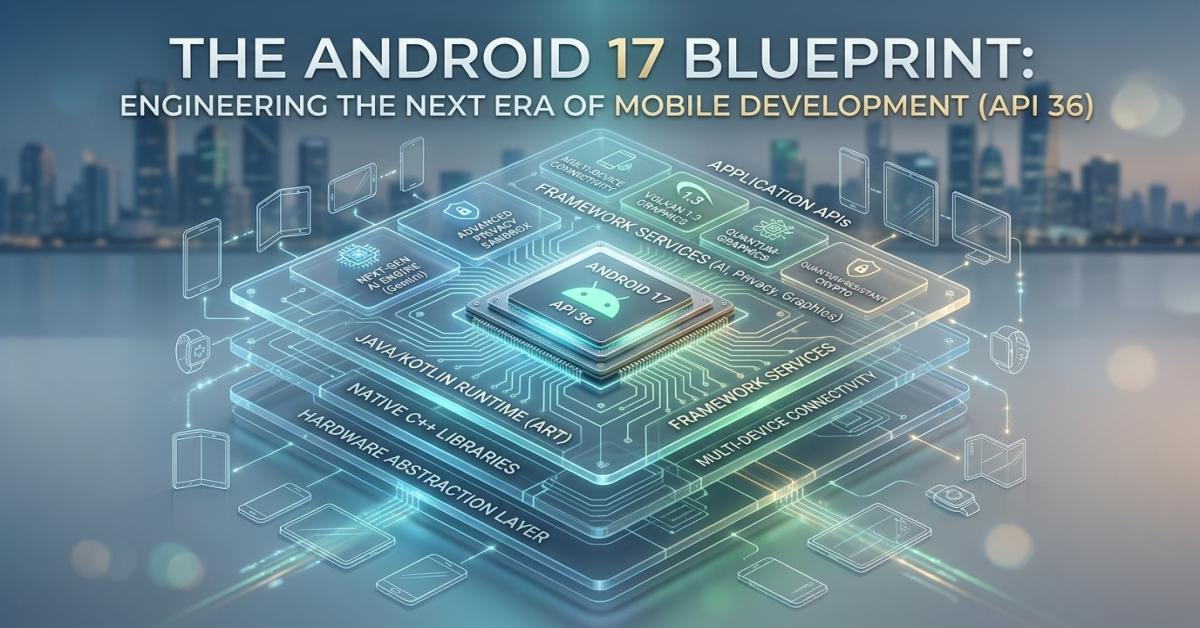
The Android 17 Blueprint: Engineering the Next Era of Mobile Development (API 36)
Stop building legacy apps. Master the architectural shifts of 2026, from Gemini Nano 2 native integration to hardware-backed Private Space 2.0 and the mandatory NTN connectivity standards.
Make Someone's Day
Share this incredible guide!
The year 2026 has officially arrived, and with it, the traditional rules of mobile app development have been rewritten. For the global developer community—especially those targeting high-tech markets in the USA, UK, Canada, and Australia—Android 17 (API Level 36) represents a seismic shift. We are moving away from "Smart Apps" and into the realm of "Cognitive Computing," where the operating system and the hardware silicon act as a single, unified brain.
As an expert Android developer and electronic circuit simulation engineer, I have spent months auditing the AOSP 17 source code. The most critical takeaway? Efficiency is the new performance. With Google's aggressive push toward on-device intelligence, your code must now be "NPU-literate." Before diving into the technical stack, ensure you have a firm grasp on the Core Android 17 AI Innovations that are powering this revolution.
1. Architecting for Gemini Nano 2: The End of Cloud Latency 🤖
In 2026, user expectations in Tier-1 countries have shifted toward instant, private, and offline responses. Android 17’s Gemini Nano 2 is not just an add-on; it is a system-level service accessible via the AI Core SDK. Developers can now offload complex multi-modal tasks—such as live audio-to-text or visual scene description—directly to the device's silicon.
Mastering the Neural Runtime (NR) API
Unlike previous versions where AI tasks were a "black box" for developers, API Level 36 gives you granular control over Model Quantization and Weight Offloading. If your app is built for a premium market, you must utilize the NR API to ensure your AI features don't drain the battery. For a deep dive into how modern hardware handles these intensive tasks, review the Android 17 Hardware Requirements and Compatibility Guide.
2. The Connectivity Revolution: Programming for the Stars 🛰️
Android 17 marks the formal introduction of Direct-to-Cell Satellite Connectivity as a standard developer tool. This isn't just for emergencies anymore; it's a new connectivity tier. The ConnectivityManager now exposes a TRANSPORT_SATELLITE flag that demands a completely different networking logic.
Handling the Non-Terrestrial Network (NTN) Latency
When your app detects a satellite link, you cannot use standard JSON-over-HTTPS for non-essential tasks. The latency and cost of satellite data require Binary Serialization (Protobuf) and strict data prioritization. Developers who ignore this will see their apps flagged by the system for excessive resource usage. Check our Technical Guide to Satellite Talk to understand the underlying infrastructure.
- Adaptive UI: Automatically switch to an "Offline-First" or "Satellite-Optimized" interface when the NTN flag is active.
- Batch Processing: Queue non-urgent data transfers for when the device re-enters 5G or Wi-Fi 7 range.
3. Security Engineering: Navigating Private Space 2.0 🛡️
For developers in the USA and Europe, security compliance is non-negotiable. Private Space 2.0 in Android 17 is a fortified sandboxing environment. When an app is installed within this space, its UID and GID are completely isolated from the primary user profile, and its data is encrypted with a unique, hardware-backed key.
If your app relies on cross-app communication or shared storage, it will fail unless you implement the Cross-Profile Content Provider protocols correctly. This is part of the broader Android 17 Security & Privacy overhaul, which every developer must audit to avoid being delisted from the Play Store.
4. The Performance Blueprint: Thermal Throttling & ADPF 🌡️
As a circuit engineer, I can tell you that the Snapdragon 8 Gen 5 is a beast, but it generates significant heat during sustained workloads. Android 17’s Android Dynamic Performance Framework (ADPF) is now mandatory for high-tier apps. Your app should actively "listen" to the device's thermal state and adjust its workload—such as reducing frame rates or AI inference depth—before the OS intervenes and kills the process.
Power Optimization Tip: Use the new BatteryUsageStats API to monitor how your background jobs affect the Voltage Rails. High-frequency pings lead to rapid battery degradation. Learn more about doubling device longevity in our AI-Powered Battery Care Guide.
5. Legacy Hardware & The GSI Ecosystem 🛠️
While we build for the future, we must acknowledge the enthusiast community. The Android 17 GSI (Generic System Image) allows developers to test their apps on older hardware that supports Project Treble. This is vital for ensuring your app is accessible to users who haven't yet upgraded to the latest flagship.
- Flashing Guide: Download & Install Android 16/17 GSI
- Early Access: Android 17 Beta Hidden Settings for Developers
- Optimization: Android 17 Hidden Developer Options Guide
Final Verdict: The Era of Intelligent Engineering
Android 17 is not a minor iteration; it is an architectural rebirth. As developers, our role has evolved from merely "building apps" to "engineering experiences" that are deeply integrated with the hardware's thermal, neural, and security layers. Stay ahead of the curve, optimize for the NPU, and respect the satellite connectivity constraints. The future of mobile is cognitive, and it starts with API Level 36. ⚡
Stay Informed:
Android 17 SDK, API Level 36, Android Developer 2026, Gemini Nano 2 integration, Android Thermal Management, Private Space 2.0 security, Mobile OS architecture 2026.
Guide Details
| Views | 55 |
| Category | Android Updates & News |
| Published | 26-Mar-2026 |
| Last Update | 11-Jun-2026 |
|
30
|
|